
ABOUT THE TREATMENT
As we age, collagen breaks down, leading to a loss of skin strength and elasticity. Ultherapy is an FDA-cleared and TGA-listed non-surgical skin tightening procedure designed to counteract these signs of aging.
Unlike lasers or radiofrequency, Ultherapy bypasses the surface of the skin, delivering focused ultrasound energy to the foundational layers typically addressed in cosmetic surgery. This energy triggers a natural response under the skin, jumpstarting the regenerative process that produces fresh, new collagen (a process known as neocollagenesis).
Key Benefits of Ultherapy at Dermedica:
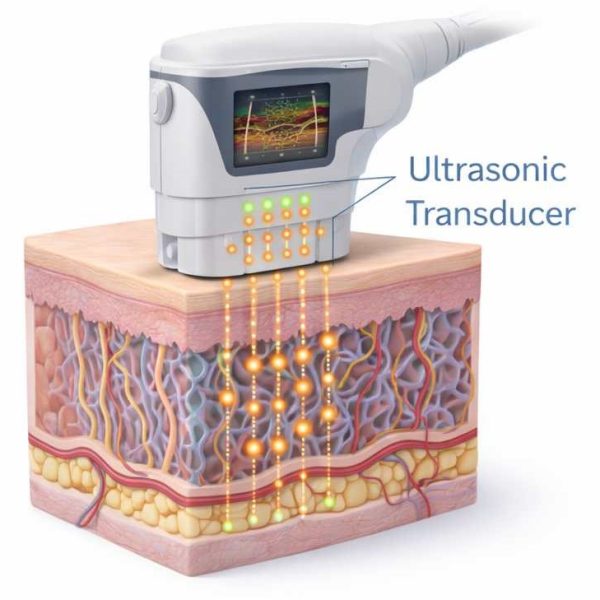
Illustration: Ultrasound energy bypassing the skin’s surface to reach and heat specific deeper layers (e.g., dermis and SMAS)
REAL PATIENTS. REAL RESULTS.


At Dermedica, all treatments are under the guidance of Dr. Joanna Teh
(General and Specialist Registration – General Practice – MED0001531429) and her team of experienced Nurses and Dermal Therapists.
*Representative examples, individual results may vary. Some patients may require 1 or more treatments. To find out if you will achieve these results, we recommend a thorough assessment with Dr Joanna Teh and her team
Your Treatment Journey
Step 1
Consultation
An in-person assessment with Dr. Teh or her team to discuss your goals, assess your suitability, and explain the treatment in full, including risks and alternatives.
Step 2
Treatment Plan
If suitable, a personalised plan is created — including the number of areas, expected sessions, and realistic timeframes specific to your goals.
Step 3
The Session
Ultrasound technology with real‑time imaging precisely targets deep tissue layers. Treatment typically lasts 30–90 minutes depending on the area. Patients often describe the sensation as tingling warmth.
Step 4
The Review
Dr. Teh’s team will follow up to review your progress over time and discuss whether further sessions may be appropriate for your goals.
The Process
Mechanism of Action
Suitable For
Treatment Experience
During the Session
Patients often describe the sensation as a warm, tingling feeling as ultrasound energy penetrates deep tissue layers. Real‑time imaging ensures precise targeting, and your practitioner monitors comfort throughout.
After Your Session
Most patients resume normal activities immediately. Mild redness, tenderness, or tingling may occur in the treated area but typically resolves within hours to a few days.
Timeframes
Results develop gradually as collagen rebuilds. Visible lifting and tightening appear over 2–3 months, with improvements continuing as your body produces new collagen. Dr. Teh will discuss realistic timelines for your specific treatment areas during consultation.
Is It Right for You?
Often Considered By
Adults noticing skin laxity in the brow, chin, neck, or décolletage
People seeking a non‑surgical lift with minimal downtime
Patients wanting gradual, natural results through collagen stimulation
Those who have discussed their skin goals and health history with a doctor
Always Discuss at Consultation
Your Treating Doctor
Dr. Teh has over 20 years of clinical experience in non-surgical cosmetic medicine. Every Ultherapy treatment plan at Dermedica begins with an in-person assessment to determine suitability and design a plan specific to you.
Treatment Cost
The cost of Ultherapy depends on the number of areas treated, the size of each area, and the number of sessions recommended for your individual goals. Dr. Teh will provide an accurate, itemised quote following your consultation.
Ultherapy may be suitable for individuals with mild to moderate skin laxity, where the skin begins to look and feel less firm. Examples can include a lowered eyebrow line, loose skin on the neck, sagging under the chin, and lines or wrinkles on the chest. While it does not replicate the results of a surgical facelift, it may be an option for those not ready for surgery or for patients looking to maintain the effects of previous cosmetic procedures. If other ageing concerns are also present, combination treatments may be discussed during consultation.
At Dermedica, the process begins with a comprehensive consultation, where Dr. Joanna Teh assesses your skin, discusses your goals, and determines whether Ultherapy is appropriate for you. During the procedure, the applicator is placed against the skin and ultrasound energy is delivered to precise depths. Comfort levels vary between individuals, and the sensation is typically felt only while the energy is being delivered. There is generally no downtime, although some patients may experience temporary redness, mild swelling, or tenderness. All medical procedures carry risks, and a thorough consultation is required to assess suitability and discuss possible side effects.
Ultherapy has a well‑established safety profile. It has been used in over 2 million treatments worldwide and uses ultrasound energy, which has been safely used in the medical field for over 50 years.
Because the procedure works by stimulating your body’s own collagen production, the duration of results depends on your individual ageing process. Patients generally see optimal results 2 to 3 months after treatment, and improvements may last up to a year or longer. Periodic maintenance treatments may be recommended.
Comfort levels vary among patients. Some people describe a warm or prickly sensation while the energy is being delivered, which indicates that the collagen‑building process has been initiated. Pain management options can be discussed during your consultation to help maximise comfort.
Ulthera may be used to lift and tighten skin on the neck, under the chin, and on the brow, and to improve the appearance of lines and wrinkles on the décolletage or upper chest area.
Ulthera uses micro‑focused ultrasound energy with real‑time visualization. This allows precise targeting of specific tissue layers for collagen stimulation and skin tightening. Compared with some other skin tightening treatments, the imaging capability can support treatment precision, safety, and customization.
Dermedica offers expert care under Dr. Joanna Teh, who has over 20 years of experience in cosmetic medicine. Her expertise ensures safe, personalised treatments with advanced technology for optimal results.
Dermedica welcomes patients from Scarborough, City Beach, Trigg, Doubleview, Wembley Downs, and the greater Perth area. Treatment is available by appointment at our Scarborough clinic.
Related treatments

Fat Freezing (Cryolipolysis)
A cooling-based alternative for addressing localised fat, suitable for patients who prefer a non-heat-based approach.

TruSculpt Flex
A muscle stimulation treatment that may be combined with fat-reduction treatments as part of a broader body contouring plan.

Exilis Skin Tightening
For patients with skin laxity in addition to fat concerns, a combined approach may be discussed at your consultation.
Get Started
Book an in-person consultation with Dr. Joanna Teh to discuss your goals and find out whether Ultherapy is suitable for you.
Whether you want to chat with Dr Joanna Teh and her team of experts or lock in a booking, we’re here to guide you to make the right decision. Fill in the form below to explore your options with total confidence.
Breakouts and post-acne marks on the chest that may appear as red spots, dark pigmentation, or uneven texture.
Tiny red or purple veins visible on the surface of the chest, commonly resulting from sun damage or skin thinning.
Small, red vascular bumps on the chest that are benign but may increase in number with age.
Thin, wrinkled skin on the chest that lacks firmness and elasticity, typically due to sun exposure and ageing.
Patchy brown or grey pigmentation on the chest, often triggered by sun exposure, hormones, or inflammation.
Dark spots or uneven skin tone on the chest, often caused by sun exposure or ageing.
Loose or drooping skin on the chest caused by collagen loss and decreased skin elasticity over time.
Active breakouts or lingering scars in the neck area, which can range from red marks to deeper textural changes.
Visible small red or purple blood vessels just under the skin, often caused by sun exposure, ageing, or skin trauma.
Small, bright red spots caused by clusters of blood vessels, typically harmless but can become more prominent with age.
Thin, finely wrinkled skin that resembles crepe paper, often due to collagen loss and sun damage.
Brown or grey-brown patches on the neck caused by hormonal changes, sun exposure, or skin inflammation.
Uneven skin tone caused by sun damage, ageing, or inflammation, leading to dark spots or patches on the neck.
Loss of firmness and elasticity in the neck area, commonly associated with ageing and decreased collagen production.
Breakouts around the chin are often hormonally driven and can lead to lingering scars, texture irregularities, or pigmentation.
A flat, receding or uneven chin can subtly impact your facial balance. Restoring shape and projection in the chin area can enhance harmony, confidence, and the way you’re perceived in profile.
Horizontal lines or deep creases across the chin often develop with age or repeated muscle movement, contributing to a tired or aged look.
Sun exposure or post-inflammatory changes can cause dark spots, uneven skin tone, or freckles to form on the chin area.
Do you notice persistent redness or small red veins around your chin? These may be signs of broken capillaries or spider veins — a common concern that often becomes more visible with age or sensitivity. While subtle, they can affect how you feel in photos, under makeup, or in daylight.
Loss of skin firmness along the jawline and lower face can lead to the appearance of jowls and deepened marionette lines, often due to aging, collagen loss, or gravity.
Marionette lines and jowls can create a downturned expression, making the face appear sad or fatigued even when well-rested.
Chronic sun exposure accelerates collagen breakdown, leading to premature skin aging, uneven tone, and deeper lines around the mouth and jaw.
A double chin refers to the appearance of excess fat or sagging skin beneath the chin and along the jawline. It can be caused by aging, genetics, poor skin elasticity, or weight gain. This concern may lead to a softer jawline and less facial definition, even in people with a healthy weight.
Accumulation of fat under the chin that creates a “double chin” appearance.
Loosened or lax skin under the chin and jawline, often due to ageing or weight changes.
Smile lines, or nasolabial folds, are the natural creases that run from the nose to the mouth. They can become more prominent over time due to ageing and facial movement.
Reducing lower face fullness (often from muscle or fat) to create a more contoured, V-shaped appearance
Laxity along the jawline can cause jowls and blur the definition of the lower face.
Treatments aim to tighten the skin and enhance jawline definition for a sculpted, youthful look.
Rejuvenation of the jawline with a focus on skin tightening and revitalising tired or heavy-looking lower face.
Inflammatory acne and lingering scars on the cheeks can impact skin texture and confidence.
Sun-induced spots or uneven skin tone often appear prominently on the cheeks, creating a mottled or patchy appearance
A lack of definition or volume in the cheek area may affect overall facial balance and profile.
Hormonal pigmentation commonly affects the cheeks in symmetrical brown or greyish patches, often triggered by sun and heat.
Loss of volume and firmness in the cheeks can lead to a drawn or aged appearance.
Redness, flushing, and visible veins frequently affect the cheeks, especially in sensitive or rosacea-prone skin.
Fine lines, volume loss, and dryness around the lips can develop with age, affecting lip shape and definition
Dark patches or uneven tone may appear on or around the lips due to sun exposure, hormonal changes, or inflammation
Breakouts around the mouth and chin can lead to inflammation and scarring, often worsened by hormonal fluctuations or mask-wearing.
Breakouts and post-inflammatory marks commonly appear on the nose due to excess oil and clogged pores
Small brown spots or uneven skin tone caused by sun exposure can concentrate on the bridge and tip of the nose.
Discolouration beneath the eyes that can make the area appear shadowed or tired.
The nose often shows enlarged pores and blackheads due to high sebaceous activity and buildup.
Though more common on the cheeks and forehead, melasma may appear on the nose as symmetrical brown patches triggered by hormones and sun exposure.
Fine lines that appear around the outer corners of the eyes, often more noticeable with facial movement or smiling.
Discolouration beneath the eyes that can make the area appear shadowed or tired.
A heaviness or sagging appearance of the upper eyelid area, which can contribute to a more tired or aged look.
Mild swelling or puffiness under the eyes, often associated with fluid retention or skin changes over time.
A common concern where the eye area may appear dull, puffy, or shadowed, often giving a fatigued or less refreshed appearance.
Visible creases or folds beneath the eyes, which may become more noticeable with age or repeated facial expressions.
Improve skin texture and clarity by addressing active acne and reducing the appearance of post-acne marks.
Small, red to purple raised spots on the forehead caused by clusters of dilated blood vessels; typically harmless but can become more noticeable with age
Smooth and refresh the appearance of forehead lines caused by repetitive movement and ageing.
Help reduce the appearance of deep creases between the brows caused by repeated frowning or stress.
Fade the look of sun spots, freckles, and uneven pigmentation for a more even-toned complexion.
Support the management of hormonally triggered pigmentation with tailored skin treatments.
Enlarged pores on the forehead are often due to excess oil, aging, or sun damage, making the skin texture appear uneven.
Calm visible redness and reduce flare-ups with treatments designed for sensitive, redness-prone skin.